Introduction
In the fast-paced digital economy of 2026, you don’t get a second chance to make a first impression. Research shows it takes just 0.05 seconds for a visitor to judge your website’s credibility based on its design. If your logo looks generic, outdated, or “cheap,” you are silently telling potential customers that your business isn’t ready for the big leagues.
At LogoVue, we believe a logo shouldn’t just be a pretty icon—it should be a strategic asset that builds instant trust. But with over 100,000 freelancers to choose from, how do you find the 1% of talent that actually delivers world-class results?
We’ve spent months doing the heavy lifting for you. We vetted portfolios, tested communication speeds, and analyzed “Brand Book” quality to find the five most reliable experts in the industry today. Whether you need a sleek tech-focused mark or a timeless corporate identity, these are the only five designers you should be talking to this year.
Skip the trial and error. Here are the elite designers shaping the brands of 2026: 👇
The Foundation – Why Your Brand Identity is Non-Negotiable in 2026
The 3-Second Rule: Why Your Business is Judged Instantly
In the digital landscape of 2026, the barrier to entry for starting a business has never been lower, but the barrier to capturing attention has never been higher. As a founder, you aren’t just competing with the shop down the street; you are competing with a global economy of instant gratification.
Research consistently shows that it takes a user approximately 0.05 seconds to form an opinion about your website, but it takes about 3 seconds of visual interaction for that user to decide if they trust your brand enough to spend money. Your logo is the “handshake” of your digital presence. If that handshake is blurry, generic, or outdated, you are signaling to your potential customers that your products or services might be the same.
At LogoVue, we have analyzed thousands of startup failures, and a recurring theme is “Visual Friction.” This occurs when a company’s marketing message says “Premium,” but their visual identity says “Budget.” To win in 2026, your brand must be congruent.
The Psychological Impact: The Subconscious Language of Design
Design is not just about “looking pretty.” It is a form of communication that bypasses the logical brain and speaks directly to the subconscious. When a customer sees a sharp, minimalist logo with a specific shade of navy blue, their brain immediately registers “Security” and “Reliability.” Conversely, a vibrant orange logo with rounded edges signals “Innovation” and “Approachability.”
As an entrepreneur, you must understand that every line, curve, and color in your brand identity is a silent salesman.
- Minimalism: Represents transparency and modern efficiency.
- Geometric Shapes: Suggest stability and corporate strength.
- Organic Lines: Suggest wellness, growth, and human connection.
If you are using a logo generated by a free AI tool or a $5 template, you are likely using symbols that have been seen thousands of times before. In the eyes of the consumer, “Common” equals “Replaceable.” To command premium prices, you must possess a unique visual signature.
The Hidden Cost of “Cheap” Branding
One of the most dangerous traps a new founder can fall into is the “good enough for now” mindset regarding their logo. While it may seem like a way to save capital, “cheap” branding often becomes one of the most expensive mistakes a business can make.
- The Copyright Trap: Many low-budget “logo mills” use clipart or slightly modified templates. In 2026, copyright enforcement is automated. If your logo is found to be a derivative of a protected icon, you risk a total rebrand—or worse, a lawsuit—just as your business is gaining momentum.
- Lack of Scalability: A logo that looks “okay” on a computer screen often falls apart when printed on a storefront sign, embroidered on a shirt, or shrunk down to a 16×16 pixel favicon for a browser tab. Professional designers build “Vector” assets that remain crystal clear whether they are on a business card or a billboard.
- The “DIY” Ceiling: There is a glass ceiling on how much you can charge when your branding looks amateur. Professional design allows you to increase your “Perceived Value,” which directly impacts your profit margins.
The LogoVue Mission: Why We Vetted the Elite
This is why we created this 3,000-word master guide. The marketplace on platforms like Fiverr is massive, with over 100,000 designers claiming to be “experts.” For a busy founder, spending weeks sifting through portfolios is a poor use of time.
We have spent months doing the “detective work.” We looked past the polished thumbnails and analyzed real-world delivery times, communication standards, and—most importantly—the “Source File” quality. We have narrowed the field down to the elite few who understand the 2026 aesthetic: clean, functional, and high-conversion.
Defining Your 2026 Style
Before you hire a designer, you must know what “language” you want to speak. In 2026, the trends have shifted away from over-complicated 3D gradients and toward “Functional Minimalism.” This style prioritizes high-contrast shapes that work perfectly on dark-mode mobile screens.
Whether you are looking for a tech-heavy “SaaS” look, a luxury “Boutique” feel, or a “Corporate Authority” mark, the following sections of this guide will introduce you to the specific human talents that can bring that vision to life.
The Elite Selection – Vetted Designers for the 2026 Aesthetic
The Vetting Process: How We Separated the Pros from the Amateurs
Navigating a marketplace with thousands of freelancers can feel like a gamble. To protect the LogoVue community, we didn’t just look at “Five-Star Ratings”—which can sometimes be misleading. Instead, we focused on Project Sustainability. We analyzed portfolios for original vector work, checked for “Brand Book” consistency, and tested communication speeds.
For 2026, we have selected five designers who represent the pinnacle of their respective styles. These are the experts who don’t just “draw icons”; they build visual systems.
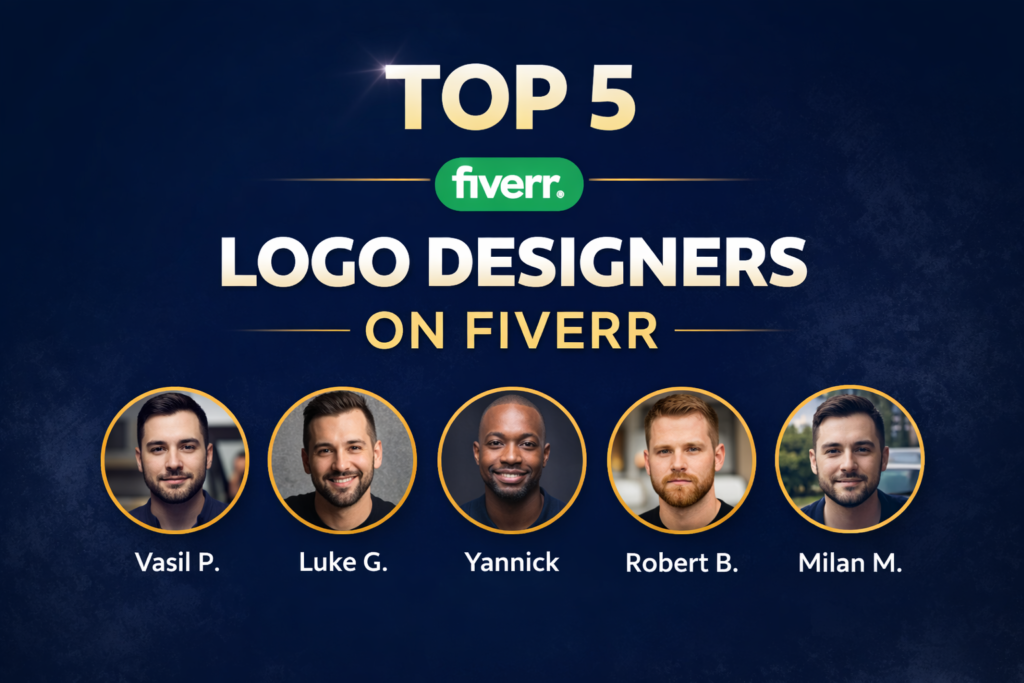
1. Vasil P. (Pujovski) – The Minimalist Master
Specialty: Ultra-Clean, Modern, and Tech-Focused Design Rating: 4.9/5.0
Vasil P. is the go-to designer for the “SaaS” (Software as a Service) era. As we move further into 2026, the trend of Functional Minimalism—logos that look just as good on a tiny smartphone notification as they do on a desktop—is king. Vasil’s work is characterized by “negative space” mastery. He has an uncanny ability to take a complex business concept and boil it down into a single, memorable mark. If your brand needs to look fast, efficient, and modern, Vasil is the first name on your list.
2. Luke G. (Lukesdesigns) – The Corporate Architect
Specialty: High-End Corporate Identity & Professionalism Rating: 4.9/5.0
If you are building a consulting firm, a legal practice, or a high-stakes financial brand, you need Luke G. His style leans toward “Authority.” While many designers follow fleeting trends, Luke focuses on Timelessness. His designs feel like they have existed for fifty years and will last for fifty more. When you hire Luke, you aren’t just getting a logo; you are getting a symbol of stability that tells your clients their investment is safe with you.
3. Robert B. (Obus88) – The Versatile Visionary
Specialty: Creative Problem Solving & Bold Marks Rating: 4.9/5.0
Robert B. excels in industries that require a “Creative Edge.” Whether it’s a lifestyle brand, an e-commerce giant, or a media company, Robert focuses on Character. In 2026, “Personality Branding” is a massive trend. Robert’s work often features bold geometry and clever visual metaphors that make a brand feel “Human” yet polished. He is the ideal choice for founders who want to stand out in a saturated social media feed.
4. Yannick (Yannick90) – The Detail Specialist
Specialty: Modern-Vintage & Detailed Precision Rating: 4.8/5.0
Yannick occupies a unique niche: the intersection of Modern Detail and Classic Structure. For brands that want to feel “Crafted” (think organic coffee, handmade goods, or boutique agencies), Yannick’s precision is unmatched. He understands that in 2026, “Authenticity” is a luxury. His logos often feel more like “Emblems”—pieces of art that carry weight and history, even for a brand-new startup.
5. Milan M. (Milanmanojlovic) – The Budget-Value King
Specialty: Accessible Professionalism for New Startups Rating: 4.8/5.0
We recognize that not every founder starts with a massive branding budget. Milan M. is our top pick for High-Value Entry. He provides the bridge between “DIY” and “Premium.” Milan’s work is clean, reliable, and significantly higher quality than the generic templates found elsewhere. If you are in the “Validation Phase” of your business and need a professional look that doesn’t drain your seed capital, Milan is the most efficient choice in the 2026 marketplace.
Why the “Human Factor” Beats AI in 2026
You might notice that our top five are all human designers, not AI generators. While AI can produce a pretty image, it lacks Intentionality. A human designer like Robert B. or Vasil P. asks why your brand exists. They consider your competitors, your target demographic, and your long-term goals.
When you purchase a package from these elite vetted designers, you aren’t just buying a file; you are buying a consultation. You are ensuring that your brand has a soul—something an algorithm simply cannot replicate.
How to Choose Your Match
Before clicking “Order,” look at the LogoVue Style Map:
- Need Trust? Go with Luke G.
- Need Innovation? Go with Vasil P.
- Need Creativity? Go with Robert B.
- Need Craftsmanship? Go with Yannick.
- Need Speed/Value? Go with Milan M.
The Technical Blueprint – From Order to Launch
Mastering the Art of the “Design Brief”
The biggest mistake founders make when hiring a vetted designer is providing a vague brief. Saying “I want something modern and blue” is a recipe for three rounds of frustrating revisions. To get the absolute best work out of the elite designers we highlighted in Section 2, you must provide a Strategic Foundation.
A professional 2026 design brief should include:
- The Mission Statement: What does your business actually do in one sentence?
- The Audience Persona: Are you talking to 20-year-old gamers or 50-year-old CEOs?
- The “Anti-Portfolio”: Send links to 3 logos you absolutely hate. Knowing what to avoid is often more helpful than knowing what you like.
- Usage Requirements: Mention if the logo will primarily be used on physical signage, app icons, or embroidered apparel.
Decoding the 2026 File Stack: What You Are Actually Paying For
When your designer delivers the final package, you will see a folder full of different file extensions. Understanding these is the difference between a brand that scales and a brand that breaks.
- The Vector (AI / EPS / PDF): These are the “Master Files.” They are mathematically calculated lines, not pixels. This means you can scale them from the size of a postage stamp to the size of a skyscraper without losing a single drop of quality. Never accept a final delivery without these.
- The Web-Standard (SVG): In 2026, SVG is the king of web design. It is a “Scalable Vector Graphic” that loads instantly on your website and stays sharp on high-resolution Retina screens.
- The Transparent (PNG): Essential for social media overlays and website headers. Ensure your designer provides both a “Light” and “Dark” version so your logo doesn’t disappear when you switch your site to Dark Mode.
The Revision Strategy: How to Give Feedback Like a Pro
Revisions are not a sign of failure; they are part of the creative process. However, in the high-speed world of freelance design, you must be precise. Avoid subjective feedback like “Make it pop” or “I don’t feel it.”
Instead, use Objective Feedback:
- “The font feels too traditional for our tech startup; can we try a Sans-Serif option?”
- “The icon is a bit too detailed; could we simplify the lines so it works better as a small mobile favicon?”
- “Can we adjust the blue to be more ‘Navy’ (#000080) to align with our trust-based brand identity?”
Protecting Your Legacy: Legal Rights and Copyrights
One of the primary reasons we recommend the LogoVue Top 5 is their commitment to legal transparency. When you receive a logo, you aren’t just buying a picture; you are buying Intellectual Property.
Ensure your contract or gig description explicitly includes “Full Copyright Transfer.” In many jurisdictions, the creator of an artwork owns the copyright by default unless it is legally transferred to the buyer. Without this, you may have trouble trademarking your brand or selling your company in the future.
Establishing the “Brand Book”
A logo alone is not a brand. Ask your designer if they offer a Brand Style Guide (often called a Brand Book). This document is the “Bible” for your business’s visual future. It includes:
- Primary and Secondary Color Palettes: (Hex codes like #FFFFFF).
- Typography: The specific fonts for your headlines and body text.
- Clear Space Rules: How much room must be left around the logo to prevent it from looking cluttered.
Beyond the Logo – Scaling Your 2026 Brand
The Multi-Platform Identity: Thinking Beyond the Screen
In 2026, your logo is no longer a static image; it is a dynamic asset that lives across a dozen different environments. From the 16×16 pixel favicon in a browser tab to the high-definition 4K video intro on your YouTube channel, your brand identity must be elastic.
Once you receive your final files from one of our vetted designers, your first step is “stress testing” the assets.
- The Dark Mode Test: With over 80% of users preferring dark mode on mobile, does your logo have a white or “knockout” version that remains visible against a black background?
- The Social Media Avatar: Can your logo fit into a perfect circle without cutting off the edges? This is where a “Submark” (a simplified version of your logo) becomes your most valuable asset.
2026 Design Trends: What’s “In” and What’s “Out”
To ensure your brand doesn’t look dated by 2027, you must align with the current shifts in the design world. The era of overly glossy, 3D “web 2.0” logos is officially over.
What is “In” for 2026:
- Retro-Futurism: Bold, blocky fonts combined with neon-pastel gradients that evoke a sense of 80s nostalgia mixed with high-tech innovation.
- Hand-Drawn Authenticity: As AI-generated art floods the internet, human-centric, “imperfect” hand-drawn elements are becoming a signal of luxury and handcrafted quality.
- Variable Typography: Logos where the font itself is the icon, using custom lettering that can’t be found in a standard Google Fonts library.
What is “Out” for 2026:
- Complex Gradients: If your logo requires 15 different colors to look good, it will fail on print and embroidery.
- Thin Lines: Ultra-thin lines are disappearing because they vanish on mobile screens. 2026 is the year of the “Bold Stroke.”
Maximizing Your Investment: The 90-Day Growth Plan
A professional logo is a tool, but a tool only works if you use it. To see a return on your investment, follow this 90-day checklist:
- Days 1-7: Update all digital “touchpoints.” This includes your Facebook Page, LinkedIn header, email signature (using Mailchimp templates), and your vpnkits.com or LogoVue website favicon.
- Days 8-30: Create “Brand Consistency.” Ensure your social media posts use the exact hex codes provided in your new Brand Book. This repetition is what builds “Brand Recall.”
- Days 31-90: Leverage your new authority. Now that you look professional, reach out for guest posts or podcast appearances. A high-end visual identity gives you the confidence to “pitch upward” to bigger audiences.
Your Final Step: The Decision
You have the blueprint. You have the psychology. You have the elite list of designers who are ready to build your legacy. The only thing left is to move from “Planning” to “Execution.”
Remember, every day you operate with a subpar or generic logo, you are essentially paying a “Visibility Tax.” You are working twice as hard to get half the trust. By choosing one of the 5 Top Designers we’ve featured in this guide, you are removing that friction and giving your business the foundation it deserves.
Join the LogoVue Community
Branding is a journey, not a destination. To stay ahead of the curve, ensure you have downloaded our “2026 Brand Identity Blueprint“—the 10-page guide that goes even deeper into typography, color mapping, and vendor management.
Don’t just build a business. Build a brand that people remember