Navigating the competitive world of online business often leads entrepreneurs to ask the frustrating question, “Why my brand persona feels unprofessional,” especially when they see competitors with less experience gaining more traction. This disconnect between your expertise and your external presentation is a common hurdle that can be dismantled with a strategic approach to your visual and verbal identity. If you feel like your brand is shouting “amateur” while you are trying to provide “expert” value, you are likely suffering from a lack of cohesive alignment between your internal mission and your external aesthetics. Understanding the specific triggers that cause a brand to feel “off” is the first step toward transforming your presence into an authoritative force that naturally attracts high-value opportunities and builds lasting trust with your ideal audience.
The Psychology of Brand Perception and Initial Misalignment
The very foundation of a professional presence begins with the psychological signals you send to your audience, and when those signals are crossed, you find yourself wondering Why my brand persona feels unprofessional in the eyes of potential leads. Every color choice, font selection, and even the “voice” of your social media captions contributes to an overall feeling of either authority or amateurism. Most beginners make the mistake of choosing elements based on personal preference—picking their favorite shade of orange or a “fun” font they saw on a hobbyist blog—without considering the deep-seated psychological associations those choices trigger. A professional brand persona is not an extension of your personal style; it is a strategic mask designed to solve a specific problem for a specific group of people. When there is a gap between who you are and who your brand represents, the resulting friction creates an aura of inauthenticity that customers can sense immediately.
To solve the mystery of Why my brand persona feels unprofessional, you must first audit your core mission and values. A common pitfall for small business owners is “identity diffusion,” where the brand tries to be too many things at once. If you are trying to be the “friendly neighbor” and the “elite corporate consultant” simultaneously, your visual identity will likely be a confusing mix of soft pastels and sharp, aggressive lines. This lack of a singular, focused persona makes the business feel unfunded and unguided. Professionalism is essentially the promise of consistency. When you provide a consistent experience across every touchpoint, from your Facebook page to your lead magnet, you signal that your business is stable and reliable. If your presence feels like a collection of random ideas, your audience will subconsciously assume your service delivery is just as disorganized.
Furthermore, a significant reason Why my brand persona feels unprofessional often stems from a lack of audience research. If your brand voice sounds like a student when your target audience consists of Fortune 500 CEOs, the disconnect is fatal to your conversion rates. You must speak the “language” of your ideal client, which includes the visual language. High-ticket clients expect “Corporate Aesthetics”—clean layouts, high-contrast typography, and a minimalist approach that respects their time and intelligence. Conversely, if you are targeting a creative, youthful audience, an overly stiff and corporate brand might actually be what feels “unprofessional” or out of touch to them. True professionalism is defined by how well you meet the expectations of your specific market, not by a generic standard of “seriousness.”
Documentation is the final pillar of this foundational step. Many solopreneurs carry their brand rules in their heads, which inevitably leads to “drift.” One day you use a specific shade of blue, and the next day you use something slightly different because you couldn’t find the hex code. Over time, these small inconsistencies pile up until you are left asking Why my brand persona feels unprofessional. A professional Brand Style Guide is the only way to lock in your identity. This document should serve as the law for your business, ensuring that whether you are writing a blog post or running a $5 daily ad, the persona remains unchanged. This level of discipline is what separates “side hustles” from “companies.” When you treat your brand with this level of reverence, your audience will naturally begin to do the same.
LEARN MORE ON BRAND STYLE GUIDE
The Visual Language and Artistic Authority
When exploring the visual reasons Why my brand persona feels unprofessional, we must look closely at the “Visual Hierarchy” of your assets. A professional brand knows exactly where it wants the viewer’s eye to go. Amateurs often clutter their designs with too much text, competing colors, and multiple “Call to Action” buttons, creating a sensory overload that feels chaotic and cheap. Professionalism is characterized by “White Space”—the intentional use of empty space to give your message room to breathe. When you allow your core message to stand alone without being crowded by distracting elements, you project a sense of confidence and clarity. If your current website or social media posts feel “busy,” that clutter is likely a primary contributor to why your brand feels less than professional.
Typography plays a massive role in the question of Why my brand persona feels unprofessional. Many beginners fall into the trap of using “display fonts” (fonts with a lot of character or decorative elements) for their body text. While these fonts are great for a logo or a single headline, they are exhausting to read in large quantities. A professional visual identity usually relies on a sophisticated “pairing” of two fonts: a Serif font for a sense of tradition and reliability, and a Sans-Serif font for modern clarity. If you are using standard system fonts like Times New Roman or Arial without a specific design intent, you are missing an opportunity to build authority. The “texture” of your typography should match the tone of your brand persona; a bold, heavy typeface says “Strength,” while a light, airy typeface says “Elegance.”
Color theory is another area where the answer to Why my brand persona feels unprofessional is often hiding in plain sight. Many beginners use too many colors, resulting in a “rainbow effect” that lacks a clear focal point. A professional palette typically consists of one dominant primary color, one or two secondary colors, and a single high-contrast accent color used exclusively for important actions like “Buy Now” or “Sign Up.” Furthermore, the saturation of your colors matters. Highly saturated, “neon” colors can feel childish or aggressive if not handled by a master designer. Muted, sophisticated tones often carry a more “Corporate Aesthetic” that signifies maturity and experience. If your colors feel like they were chosen for a birthday party rather than a business, it’s time to refine your palette toward a more strategic set of hues.
Imagery style is the final visual hurdle. If you are using generic, cheesy stock photos of people in suits shaking hands, you are essentially telling your audience that you don’t have an original thought. This is a classic reason Why my brand persona feels unprofessional. Modern professionalism demands “Authentic Imagery.” This doesn’t mean you need a $10,000 photoshoot; it means you need photos that feel real, candid, and aligned with your specific brand story. Even using stylized filters or a consistent cropping method for your stock photos can help them feel like a unified part of your brand rather than a random collection of internet images. Every image you post should feel like it was “directed” by your brand persona to tell a specific part of your business narrative.
Digital Presence and the Consistency of Experience
If you have fixed your visuals but are still asking Why my brand persona feels unprofessional, the issue likely lies in your “Cross-Platform Consistency.” In the digital age, your brand is a journey, not a destination. A customer might see your ad on Facebook, visit your profile on TikTok, and eventually end up on your landing page. If each of these steps feels like a different company, you are creating “Friction.” Friction is the enemy of professional branding. Every time a user has to pause and ask, “Wait, am I in the right place?” you lose authority. Your profile pictures, header images, and even the “bio” text must be identical in spirit and style across every single digital touchpoint. This unified front is what creates the illusion of a much larger, more established corporation.
Another subtle reason Why my brand persona feels unprofessional is the “Quality of Execution” in your micro-interactions. This refers to the small things: your email signature, the “Thank You” page after someone signs up for your lead magnet, and even the “Favicon” (the tiny icon in the browser tab). When these details are ignored, they act as “leaks” in your professional bucket. A beginner might have a great logo but a standard, boring “Sent from my iPhone” email signature. A professional, however, sees every communication as a branding opportunity. A custom-designed email signature with your brand colors and a professional headshot immediately elevates every email you send from a “person talking” to a “representative of a brand.” These micro-details are what convince people you have the “attention to detail” necessary to handle their business or provide a high-quality product.
The “Tone of Voice” in your content is equally responsible for Why my brand persona feels unprofessional. Consistency isn’t just about what people see; it’s about what they “hear.” If your blog posts are written in a very formal, academic style, but your Instagram captions are full of slang and emojis, your brand persona feels schizophrenic. You need to develop a “Brand Voice Guide” that dictates your level of formality, your use of humor, and even your stance on industry controversies. This voice should be a reflection of your brand persona. If you are the “Wise Mentor,” your voice should be calm, authoritative, and encouraging. If you are the “Disruptor,” your voice should be bold, punchy, and perhaps a bit provocative. When your voice remains consistent, people feel like they “know” your brand, which is the precursor to trust and sales.
Finally, we must address the “Technical Integrity” of your digital presence. If your website is slow to load, has broken links, or is not optimized for mobile, it doesn’t matter how pretty your logo is—your brand will feel unprofessional. In 2026, a “Small business branding mistakes beginners make” list almost always includes neglecting the mobile experience. A professional brand respects the user’s technology. Your site should be fast, responsive, and easy to navigate with one hand on a smartphone. High-quality branding is a promise of quality in all things; if your website is broken, your audience will assume your service is broken too. Investing in a solid technical foundation is just as much a “branding” activity as designing a logo or picking a color palette.
LEARN MORE ON DIGITAL PRESENCE AUDIT
Activating Your New Professional Aura
The final step in overcoming the feeling of Why my brand persona feels unprofessional is the active “embodiment” of your brand. Branding is a verb, not a noun. Once you have the style guide, the colors, and the voice, you must consistently show up as that version of your business. This is where many entrepreneurs fail; they spend weeks on the design but then revert to their old, disorganized habits once the work starts. Professionalism is maintained through the discipline of repetition. Every piece of content you produce, every client meeting you attend, and every ad you run must be filtered through your new brand persona. It may feel like “acting” at first, but over time, this persona becomes the natural exoskeleton of your business, protecting it and allowing it to grow.
One powerful way to combat the sensation of Why my brand persona feels unprofessional is to start using “Brand Templates.” Instead of creating every social media post or slide deck from scratch, create a set of 5-10 master templates that follow your style guide perfectly. This ensures that you can’t accidentally “drift” away from your professional look when you’re in a hurry. These templates save you time and, more importantly, they protect your visual integrity. When your audience sees a consistent “layout style” in their feed day after day, they begin to associate that style with your expertise. This is how “Brand Awareness” is built on a small budget. You don’t need a million dollars; you just need to be more consistent than everyone else in your niche.
Maintaining your professional brand also requires a “Feedback Loop.” Sometimes, we are too close to our own work to see Why my brand persona feels unprofessional. Ask a trusted peer or even a few loyal customers for their honest first impression of your brand. Don’t ask, “Do you like it?” Ask, “What kind of person do you think runs this company?” and “Does this look like a business you would trust with $1,000?” If their answers don’t match your intended brand persona, you know exactly where the disconnect lies. Be willing to make cold, strategic adjustments. Branding is not about your ego; it’s about the marketplace’s perception. A professional is willing to pivot their aesthetics if the data shows that their current look is not resonating with the target audience.
Finally, remember that branding is a long-term investment in “Equity.” Every month that you show up with a cohesive, professional persona, you are adding “value” to your business name. This is why you must avoid the temptation to change your look every time a new trend appears on TikTok. A professional brand is “Evergreen.” While you can refresh your imagery or tweak your accent colors, your core persona should remain stable for years. This stability is what allows a “small blogger” to eventually out-compete larger companies that are constantly rebranding and confusing their market. By following a simple checklist for a cohesive visual identity, you build a legacy of trust that becomes your most valuable affiliate asset. You have the expertise; now it is time to give it the professional home it deserves.
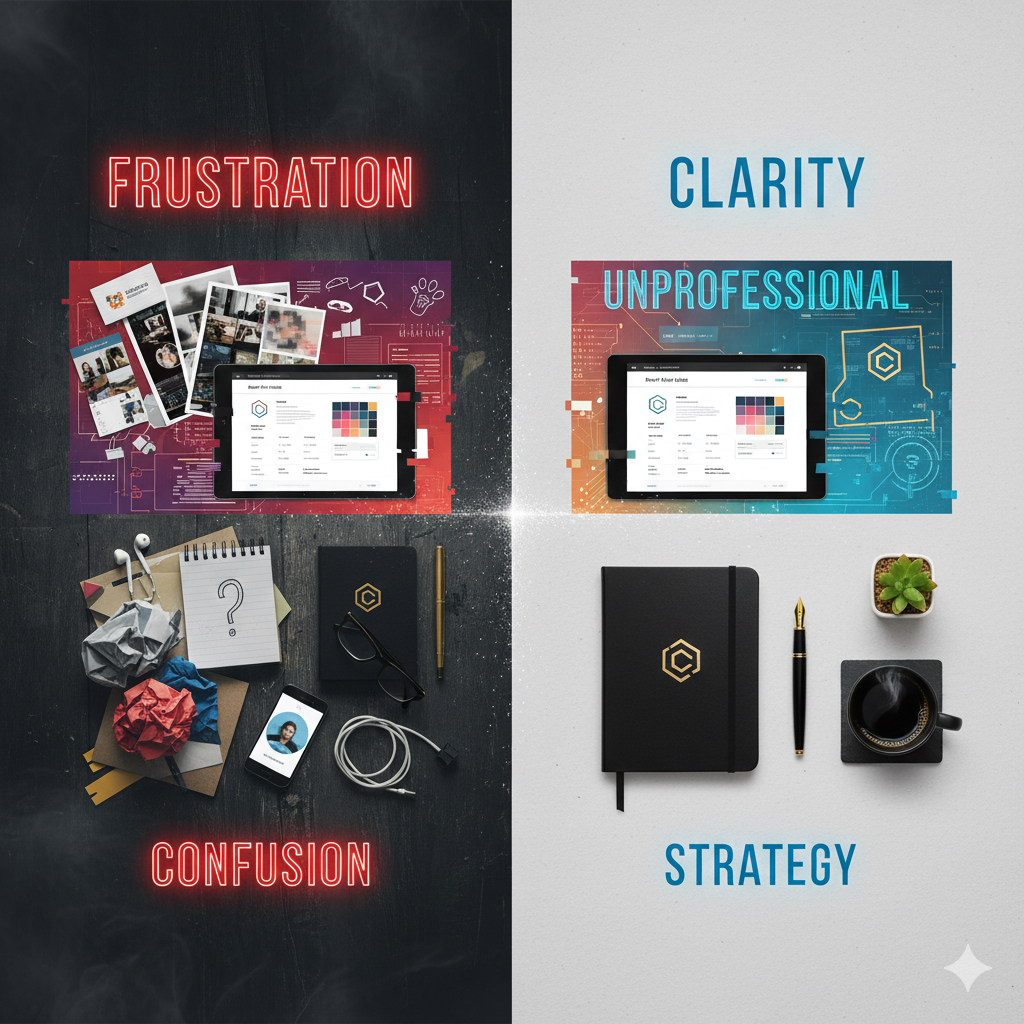
FAQ: Solving Your Brand Identity Crisis
1. How long does it take to fix the feeling of an unprofessional brand? While you can update your visuals in a weekend, it typically takes 30-90 days of consistent posting and communication for your audience to “reset” their perception of your brand. Consistency is more important than speed during this transition period.
2. Can I have a professional brand persona if I am a “solopreneur”? Absolutely. In fact, it is more important for solopreneurs to have a professional persona because they don’t have a large team to hide behind. Your branding acts as your “corporate armor,” making you appear established and capable of handling high-level tasks.
3. What is the single biggest contributor to Why my brand persona feels unprofessional? Inconsistency. If you use three different fonts, four different “voices,” and random colors across your platforms, your brand will always feel like a disorganized hobby. Pick a lane and stay in it for at least six months.
4. Do I need to show my face to have a professional brand persona? Not necessarily, but it helps with “Trust Building.” If you choose to be a “faceless” brand, your visual identity (graphics, typography, and voice) must be twice as strong to compensate for the lack of a human connection.
5. How does a professional brand persona affect my affiliate sales? People buy from people (and brands) they trust. If your brand feels unprofessional, visitors will assume your recommendations are also low-quality. A professional persona acts as a “Seal of Approval” for every affiliate link you post.
6. Should I use my own name or a business name for a professional persona? This depends on your long-term goals. A personal brand is easier to build trust with quickly, while a business name (like “LogoVue”) is easier to scale or sell later. Both can be equally professional if they follow a strict Brand Style Guide.
7. Is a professional brand persona expensive to create? No. It requires “Decision Making,” not just “Money.” You can find free high-quality fonts on Google Fonts and use affordable tools to create your style guide. The “cost” is the discipline required to stick to your rules.
Conclusion: Mastering Your Authority
The journey of business growth is often a mirror of our own internal development, and when you finally address the question of Why my brand persona feels unprofessional, you are essentially giving yourself permission to succeed at a higher level. A professional brand is not a luxury reserved for the elite; it is a foundational requirement for anyone who wants to be taken seriously in the digital marketplace. By aligning your visual language, your tone of voice, and your digital execution with a singular, well-defined persona, you eliminate the confusion that holds so many entrepreneurs back. You no longer have to wonder if your “look” is scaring away clients; instead, you can focus on providing the massive value that you were meant to deliver.
Consistency, clarity, and a deep respect for your audience’s perception are the keys to unlocking a brand that feels powerful and polished. Whether you are running a $5 ad campaign or building a massive affiliate empire, your brand persona is the vehicle that carries your message to the world. Don’t let a “messy” presence undermine your hard work. Follow the principles of professional identity, document your standards, and show up every day with the confidence of a market leader. For more advanced strategies on building trust through content, you can explore the HubSpot Branding Guide for comprehensive industry insights. The transition from amateur to authority is a choice you make every time you post, and today is the perfect day to choose a professional future. There is no longer a mystery as to “Why my brand persona feels unprofessional“—the answer is in your hands, and the solution is simply a matter of strategic execution.